My research interests lie at the intersection of computational engineering, artificial intelligence, high-performance computing, and aerospace systems.
As a computer engineer and software architect, my focus is not only on developing software, but also on building scientific computing platforms that enable advanced engineering simulations, digital engineering workflows, and AI-assisted research.
This direction began during my undergraduate research at Lovely Professional University, where I co-authored a paper presented at the 73rd International Astronautical Congress (IAC 2022) in Paris.
Published Research
Model Development and Validation of the Moon’s Radiation Environment at the Surface and Subsurface
73rd International Astronautical Congress (IAC 2022), Paris
25th IAA Symposium on Human Exploration of the Solar System (A5) · Interactive Presentations (IPB)
Paper ID 67890 · IAC-22,A5,IPB,5,x67890 · Student paper
Role: Co-author.
Authors: Akshat Mohite; Kushanthraj S N; Rohan Caulvin; Prapti Yasmin; Aniket Yadav; Jahnavi Dangeti; Istiack Mohammad. Affiliations include Lovely Professional University, India and Bangladesh.
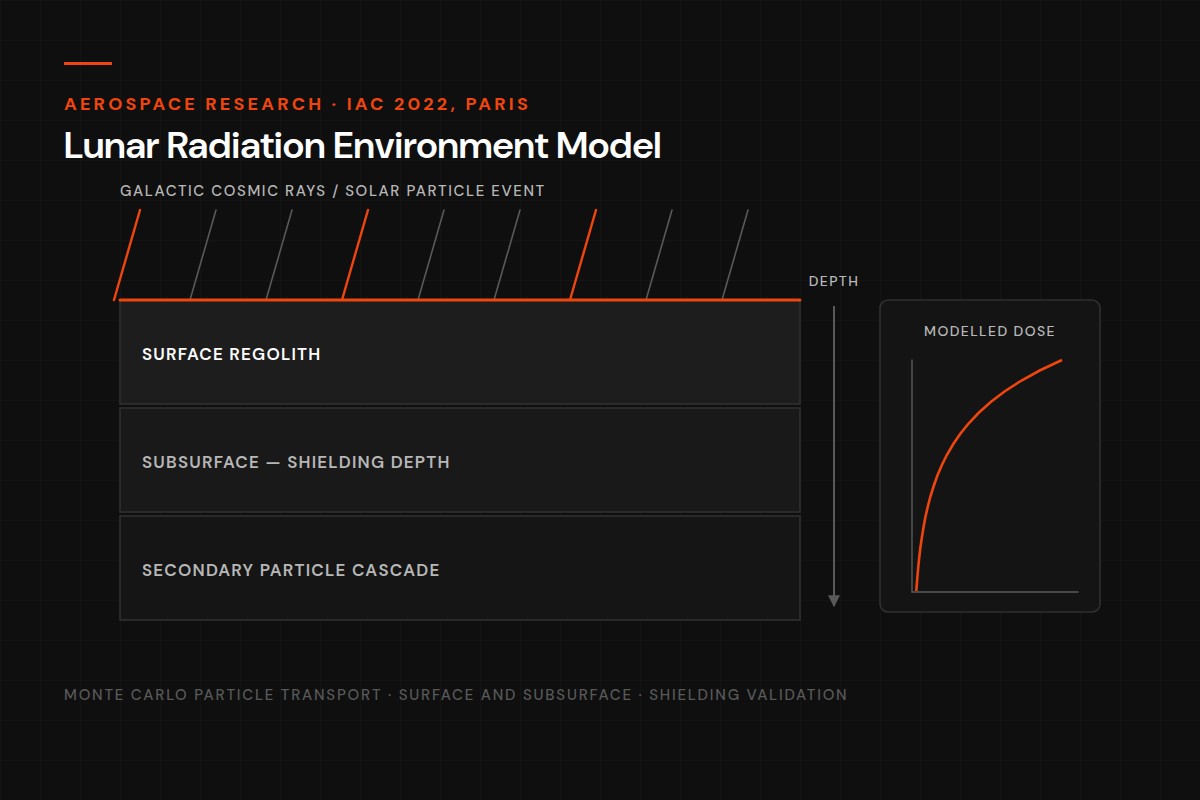
This research focused on developing and validating a computational model of the lunar radiation environment using the GEANT4 Monte Carlo simulation framework. The work investigated galactic cosmic ray interactions with lunar regolith and modeled particle transport, secondary particle generation, radiation dose, and subsurface radiation environments relevant to future human lunar exploration.
The model is named REDMoon — Radiation Environment and Dose at the Moon. It resolves particle spectra by type, energy, angle, depth and time, using GEANT4 (GEometry ANd Tracking) together with a response-function technique.
Reported findings
- Calculated radiation particle fluxes on and under the lunar surface agree with prior experimental and computational results, while adding angular and depth information that earlier work did not resolve.
- The depth profile of secondary particle spectra in lunar soil reaches a maximum between 0.5 and 1 m below the surface, depending on particle type and energy.
- Secondary particles around 1 MeV — particularly neutrons, gamma rays and electrons — show a fairly isotropic angular distribution, while higher-energy particles preferentially travel downward.
Because the Moon has no global magnetic field and no meaningful atmosphere, both primary space radiation and secondary radiation produced inside the regolith reach the surface. Characterising that field spatially, directionally and energetically is a precondition for shielding design and for siting future crewed lunar habitats.
Paper: Published abstract (PDF, IAF paper directory)
Technical Foundation
My research combines software engineering with computational physics and scientific computing, including:
Computational Methods
- Monte Carlo simulation
- Random sampling techniques
- Probability distributions
- Numerical methods
- Scientific computing
- Statistical validation
Scientific Programming
- C++
- Python
- NumPy
- SciPy
- Pandas
- Matplotlib
Physics Simulation
- GEANT4 particle transport simulation
- Radiation transport modeling
- Particle interaction modeling
- Detector geometry
- Material modeling
- Physics lists
- Event tracking and scoring
Space Environment Modeling
- Galactic Cosmic Rays (GCR)
- Solar Particle Events (SPE)
- Lunar radiation environment
- Lunar regolith interaction
- Secondary particle generation
- Radiation shielding analysis
High-Performance Computing
- Linux-based scientific computing
- CMake
- GCC
- ROOT
- OpenMP
- MPI
- Distributed simulation workflows
Current Research Direction
I am currently working toward developing an integrated computational engineering platform capable of supporting large-scale scientific simulations through modern software architecture, artificial intelligence, and high-performance computing.
The long-term vision includes:
- Radiation transport simulation
- Digital engineering platforms
- Physics-informed AI
- AI surrogate models for scientific simulation
- Autonomous engineering agents
- Digital twins
- Engineering optimization
- Computational aerospace systems
Research Philosophy
The next generation of engineering software will combine scientific simulation, artificial intelligence, and scalable software architecture into unified computational platforms.
My objective is to contribute to this evolution by building tools that help engineers, researchers, and scientists perform faster simulations, automate engineering workflows, and accelerate scientific discovery.