Introduction
The most significant shift in industrial robotics in the past five years is not a hardware development. It is a software architecture development: the emergence of Physical AI — the application of large-scale AI foundation models, learning from demonstration, and sim-to-real transfer to teach robots physical tasks rather than programming them.
EE Times headlined this shift in June 2026 as "The New Software Standard for Physical AI," noting that robotics development and deployment timelines are collapsing from months to days as new frameworks, pretrained models, and simulation environments mature. This is not hyperbole — it reflects a genuine inflection point in how robotics systems are built, programmed, and maintained.
For anyone designing mechatronic systems, this shift has real implications for how systems are structured, which skills matter, and what industrial automation looks like over the next three to five years. What follows is an analysis of the technical architecture of Physical AI and why it is changing development velocity.
I come to it from mechatronics rather than from machine learning, which shapes what I think the important question is. My interest is not primarily in how capable the policies are becoming — it is in what has to be true of the system around a learned policy before you can safely let it drive a physical mechanism. That is the argument I make before the conclusion, and it is the part I think gets least attention in the current enthusiasm.
What Is Physical AI — And Why Is It Different from Previous Robot Programming
Traditional industrial robot programming is procedural: an engineer explicitly programs every motion path, every velocity profile, every conditional logic branch. For a pick-and-place application, the engineer teaches the robot home position, approach position, grasp position, lift height, place position — every waypoint, every trajectory, every speed. This works well for highly repetitive tasks in structured environments. It fails immediately when the environment changes: different part orientations, varying part sizes, new object types.
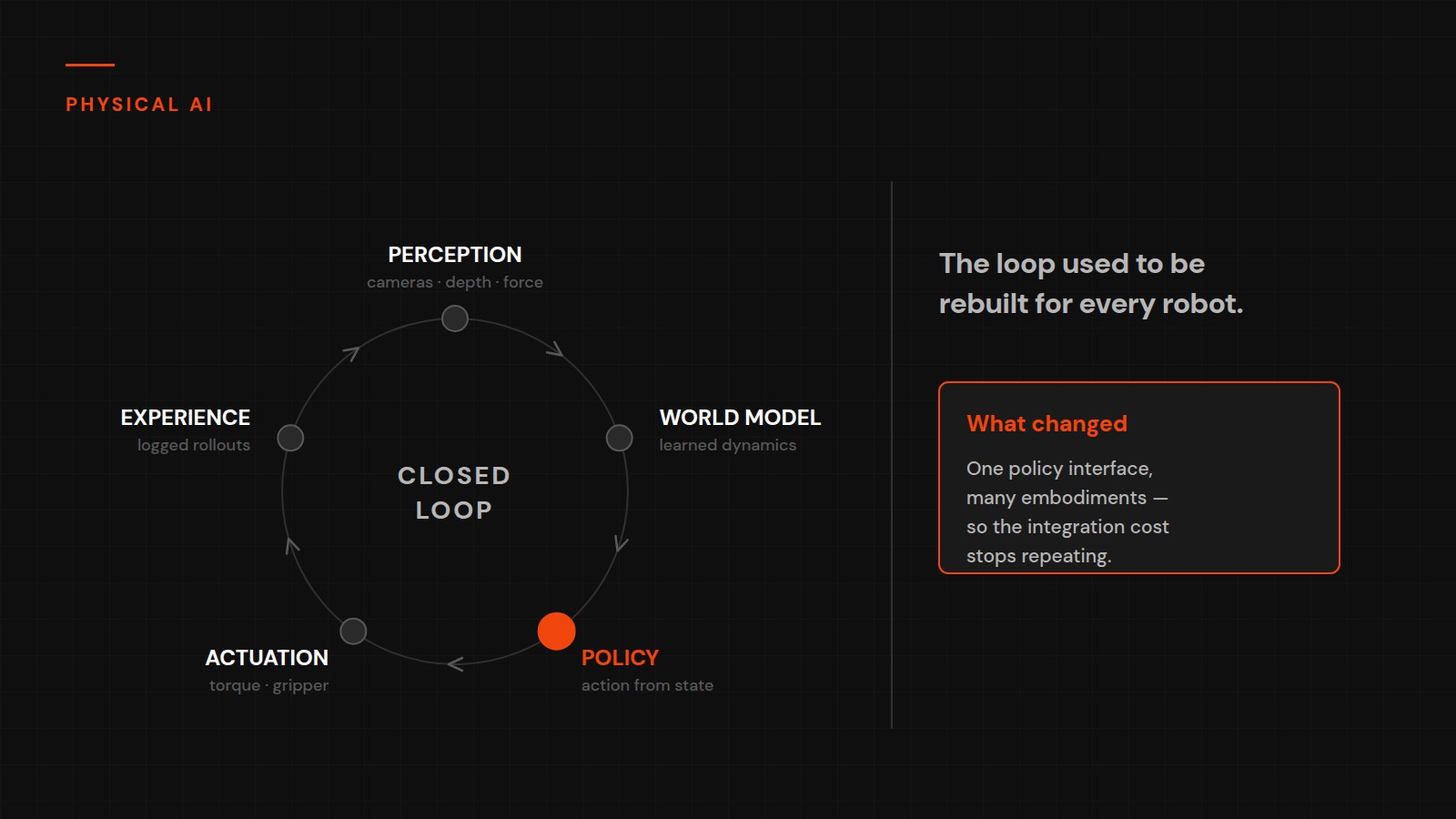
Physical AI replaces explicit programming with learned behavior. Instead of specifying how the robot should move, the system learns from: demonstrations (a human or expert robot performs the task, and the system learns the underlying policy from observations), simulation (the robot practices the task in a physics-accurate virtual environment millions of times before being deployed on the physical hardware), and real-world experience (the robot continues to improve from its own operational data after deployment).
The key innovation is the application of foundation model architectures — the same transformer-based neural network architectures that have revolutionized natural language processing and computer vision — to robot learning. A robot foundation model is pretrained on massive datasets of robot demonstrations, simulation trajectories, and sensor data, giving it a rich prior understanding of physical manipulation, object properties, and task structure. This pretrained base can then be fine-tuned on specific tasks with a fraction of the data that would be required to train from scratch.
This is the same paradigm that collapsed the cost and time of building capable NLP systems when large language models became available — applying a powerful pretrained base to specific tasks rather than building from scratch for every application. The same efficiency gain is now arriving in physical robotics.
The Key Technical Components of Physical AI Architecture
1. Robot Foundation Models
Foundation models for robotics — trained on diverse demonstrations and simulation data — provide the base capability from which task-specific policies are derived. Notable examples in 2026 include Google DeepMind's RT-2 (which extends vision-language model capabilities to robotic action), Physical Intelligence's π0 (trained on diverse manipulation data from multiple robot embodiments), and NVIDIA's Isaac Lab foundation model infrastructure.
These models represent months of training on thousands of GPU-hours, producing a general manipulation capability that would be impossible to achieve by training on task-specific data alone. The practical implication: a robotics engineer fine-tuning one of these foundation models for a specific task can achieve deployment-ready performance with hours or days of task-specific demonstrations rather than months of programming and manual trajectory design.
2. Simulation and Sim-to-Real Transfer
Simulation environments that accurately model physics — contact dynamics, deformable objects, material properties, actuator behavior — are the training ground for Physical AI systems. The robot can practice a task millions of times in simulation at 1000x real-time speed, exploring the full distribution of task variations (different object positions, sizes, orientations, lighting conditions) without wearing out hardware or risking expensive failures.
Sim-to-real transfer — the ability to deploy a policy trained in simulation onto the physical robot without significant performance degradation — has been a long-standing challenge in robotics. Advances in physics simulation fidelity (NVIDIA Isaac Sim, MuJoCo, Genesis), domain randomization techniques (systematically varying simulation parameters during training to build robustness to sim-to-real mismatch), and adaptive fine-tuning (brief real-world data collection to adapt the policy after deployment) have substantially closed the sim-to-real gap for manipulation tasks in 2025–2026.
3. Learning from Demonstration at Scale
Imitation learning — learning robot behavior from human demonstrations — has been transformed by the scale at which demonstrations can now be collected. Teleoperation systems using VR controllers, exoskeleton-based demonstration, and dexterous robot hands controlled by human operators allow skilled humans to efficiently demonstrate complex manipulation tasks. The Open X-Embodiment dataset (contributed by multiple research labs) contains over 1 million robot demonstrations across hundreds of tasks and robot embodiments — the kind of dataset diversity that enables foundation model training.
For industrial applications, this means: instead of spending weeks programming a robot to handle a new part variant, a technician can demonstrate the task 20–50 times using a teleoperation interface, and the robot learns a generalizable policy from those demonstrations. This changes the economics and timeline of deploying robotics to new tasks dramatically.
4. Hardware-Software Co-design for Physical AI Execution
Physical AI policies — the neural network models that map sensor inputs to robot actions — must execute in real time on robot hardware. For manipulation tasks, this means inference latency of 10–50ms to maintain reactive behavior at full control frequency. Current physical AI models (typically transformer-based with tens to hundreds of millions of parameters) require substantial compute for inference at this latency target.
NVIDIA's GROOT (Generalist Robot 00 Technology) and Isaac Lab platforms are specifically designed to provide the compute infrastructure — Jetson Orin and next-generation edge AI chips — and software stack (ROS 2 integration, Isaac ROS) for deploying Physical AI policies on real robot hardware at production-viable inference rates. This hardware-software co-design layer is what bridges the gap between research Physical AI results and production industrial deployment.
What Physical AI Changes About Industrial Robotics Deployment
The traditional industrial robotics deployment model involves extensive engineering effort: robot selection, mechanical integration, safety engineering, PLC programming, motion programming, teach-in or offline programming, testing, commissioning. For a complex assembly cell, this process takes weeks to months even for experienced integrators.
Physical AI changes this at two critical stages: task specification and adaptation to variation.
Task specification time collapses from weeks of programming to hours or days of demonstrations. An engineer or trained technician demonstrates the task — grasping a component, inserting it into a fixture, applying a fastener — and the Physical AI system learns the task policy from those demonstrations. No explicit motion programming. No coordinate teaching. No manual trajectory design.
Adaptation to variation changes from expensive re-programming events to automatic learning. When a part variant is introduced, the operator provides a small number of additional demonstrations for the new variant, and the policy updates — in hours, not weeks. When a robot is relocated to a different cell with slightly different spatial configuration, domain adaptation techniques compensate without full reprogramming.
These two changes — in task specification time and in adaptation cost — are what compress the robotics deployment timeline and dramatically expand the range of tasks for which automation is economically viable. Tasks that were previously too variable, too low-volume, or too frequently-changing to justify automation become accessible to Physical AI-based robotic systems.
The Unitree Moment — Why Chinese Robotics Speed Matters
SemiAnalysis published a significant analysis in June 2026 titled "China's Unitree Will Dominate Global Robotics," making the case that Unitree Robotics has achieved the fastest iteration cycle in the next-generation robotics industry. This claim is rooted in a hardware and software development velocity that produces new robot generations and new capability improvements at a pace that established robotics vendors cannot match.
The intersection of Physical AI software (foundation models, sim-to-real) with hardware platforms that can rapidly iterate — lower cost, faster design cycles, more aggressive performance targets — is what makes Unitree's trajectory significant. Physical AI software works best on hardware that has been designed for it: high-bandwidth sensor suites, sufficient onboard compute for policy inference, actuators that can execute the high-frequency commands that Physical AI policies generate.
For the industrial automation community globally, this is a competitive dynamics signal: the Physical AI transition is not just about software sophistication. It is about which hardware platforms and software ecosystems enable the fastest capability iteration. Engineers who understand both the hardware architecture of Physical AI-capable robots and the software frameworks that run on them will navigate this transition most effectively.
What Practicing Engineers Need to Do Now
Physical AI is not a replacement for the mechatronic engineering disciplines — it is an extension of them. Control theory, sensor integration, real-time systems, mechanical design — all of these remain essential. What Physical AI adds is a new layer of capability development that traditional programming cannot provide.
For engineers who want to stay ahead of this transition, three competencies are becoming increasingly important: proficiency with simulation environments for robot training and testing (Isaac Sim, MuJoCo, Genesis); understanding of transformer-based neural network architectures as applied to robot learning (attention mechanisms, sequence modeling, policy representation); and experience with the hardware-software integration layer for Physical AI deployment (ROS 2, Isaac ROS, real-time inference deployment).
These are not replacements for embedded systems expertise or control engineering knowledge. They are additions to the stack that make a mechatronic engineer far more capable in a world where Physical AI is becoming the standard approach for complex robotics applications.
Why physical AI is not simply AI with actuators attached
The distinction I would insist on is this: physical AI is fundamentally different from ordinary software AI because an incorrect decision can damage hardware or create an unsafe condition. That sentence is easy to nod along to and has consequences that are frequently not followed through.
In a software system, a wrong output is usually recoverable. A bad recommendation is ignored, a bad classification is corrected, an erroneous response is regenerated. The cost of being wrong is bounded and the system remains available while you fix it. None of that holds once the output is torque. A wrong action can destroy the mechanism producing it, damage the workpiece, or injure someone standing nearby — and it happens at the speed of the actuator, not at the speed of anyone supervising it.
What follows is that the learned policy cannot be the whole system. It needs sensing it can be held accountable against, control underneath it that remains stable when the policy produces something unexpected, fault handling that detects an implausible command before it is executed, and deterministic behaviour around it so that the machine’s response to a fault is defined rather than emergent. The policy is one component inside a mechatronic system that has to be safe whether or not that component behaves.
This is not an argument against the technology. The development-velocity gains described above are real, and teaching a robot a task by demonstration rather than by explicit programming is a genuine change in what is practical to build. It is an argument about which part of the work the new tools actually remove. They substantially reduce the effort of specifying behaviour. They do not reduce — and arguably increase — the effort of bounding behaviour, because a learned policy is harder to reason about exhaustively than a state machine somebody wrote by hand.
So the skill I would expect to become more valuable, rather than less, is the traditional one: knowing how to build a system that fails safely. Faster iteration on capability makes the surrounding safety architecture more important, not less, because the thing being iterated on is now something no one can fully enumerate the behaviour of.
Conclusion
Physical AI is the new software standard for robotics — and it is compressing deployment timelines from months to days for an expanding range of tasks. Foundation models trained on diverse demonstration data, high-fidelity simulation for policy training, and hardware platforms capable of real-time policy inference are the three technical pillars of this transition. The EE Times headline from June 2026 accurately captures the inflection: the software stack for physical robotics is being rebuilt, and the engineers who understand both the hardware architecture and the new software paradigm will define what industrial automation looks like in 2027–2030.
This is not a technology to watch from a distance. It is a technology to engage with actively, build competence in, and apply to real problems — starting now.